
How to Track SEO Conversion Rate with PostHog: The Entity-First Approach That Scales Revenue

Get weekly strategy insights by our best humans

Your organic traffic just hit an all-time high. Dashboard screenshots are flying in Slack. But when you dig into actual signups, purchases, or qualified leads? The numbers tell a different story.
Here's what's happening: You're measuring vanity metrics instead of building a conversion tracking system that scales with your knowledge graph. While most teams chase GA4 tutorials and UTM Band-Aids, smart operators are using PostHog to create entity-first attribution loops—where every organic visitor becomes trackable revenue data, and every content cluster reinforces your competitive moat. This isn't just analytics; it's turning your SEO conversion rate into a compound growth engine that feeds back into your content strategy, scales your topical authority, and proves ROI to investors who care about unit economics, not traffic spikes.
Why Does Your SEO Conversion Rate Feel Like a Black Box?
The disconnect between organic traffic and revenue isn't a tracking problem—it's an attribution architecture problem. Most teams inherit fragmented systems where UTM parameters disappear, macro conversions hide micro-signals, and monthly SEO reports become exercises in creative storytelling rather than data-driven optimization.
The Gap Between Organic Traffic Spikes and Revenue Reality
When your SEO traffic doubles but conversions stay flat, you're experiencing what the Postdigitalist team calls "entity drift"—the phenomenon where visitors from different topical clusters behave completely differently, but your analytics treats them as homogeneous "organic traffic."
A visitor who discovers your brand through a bottom-funnel comparison post carries different intent than someone landing on a top-funnel educational piece. Yet traditional tracking systems lump these journeys together, making it impossible to identify which content entities actually drive revenue growth versus those that just inflate vanity metrics.
This creates a cascading problem: without conversion attribution by entity, you can't optimize your content clusters. Without cluster optimization, your internal linking becomes random. Without strategic internal linking, your topical authority stagnates. The result? Your SEO program scales traffic without scaling revenue.
Common Pitfalls: UTM Loss and Macro-Only Tracking
The most expensive mistake in SEO conversion tracking happens in the first 30 seconds of a visitor's journey. UTM parameters—your primary source of attribution data—get stripped by redirects, lost in multi-page sessions, or overwritten by direct navigation. By the time a conversion event fires, the organic source signal has vanished.
Even worse, most teams only track macro conversions like form submissions or purchases, missing the micro-conversion signals that reveal true entity performance. When someone spends four minutes reading your pillar content, downloads a resource, or engages with embedded tools, these interactions predict future revenue better than raw traffic volume. But without proper event architecture, this predictive data disappears into the void.
The compound effect is devastating for resource allocation. Teams double down on content topics that generate traffic but terrible conversion rates, while underinvesting in entity clusters that drive qualified leads. The solution isn't better UTM hygiene—it's building an analytics system that captures attribution across the entire customer journey.
What Makes PostHog the Ultimate Tool for SEO Conversion Tracking?
PostHog fundamentally changes how you think about SEO attribution by treating every visitor interaction as a trackable event within your broader product ecosystem. Instead of trying to bridge the gap between content consumption and revenue outcomes, you create a unified data model where organic discovery becomes part of your product-led growth flywheel.
Autocapture vs. Manual Events: Instant Entity Signals
PostHog's autocapture functionality eliminates the most common failure point in SEO tracking: incomplete event implementation. Rather than manually defining every trackable interaction and hoping developers implement them correctly, autocapture automatically records page views, clicks, form interactions, and custom properties without additional code.
For SEO operators, this means instant visibility into entity-level performance. When someone lands on your pillar content about "API documentation best practices," PostHog automatically captures the page URL, referrer data, and subsequent interaction patterns. You can immediately see which content entities drive deeper engagement versus bounce-heavy traffic.
But the real power emerges when you combine autocapture with custom events. While PostHog tracks standard interactions automatically, you can layer on business-specific signals like "Demo Request from SEO" or "Pricing Page from Entity Cluster" to create conversion funnels that directly tie organic discovery to revenue outcomes.
Funnel and Cohort Advantages Over GA4
GA4's funnel analysis treats attribution as a linear path from source to conversion, which fundamentally misunderstands how modern buyers engage with content-driven brands. PostHog's funnel system recognizes that SEO conversions happen across multiple sessions, devices, and touchpoints—then provides cohort analysis to track long-term revenue impact from organic acquisition.
Here's the practical difference: In GA4, an organic visitor who reads three blog posts, downloads a resource, and converts two weeks later shows up as a direct conversion with no organic attribution. PostHog maintains the attribution thread across the entire journey, letting you prove that your entity-first SEO strategy directly influenced revenue outcomes.
The cohort functionality takes this further by grouping users based on acquisition patterns. You can create cohorts like "Organic visitors from API content cluster" and track their lifetime value, retention rates, and expansion revenue. This transforms SEO from a top-of-funnel vanity play into a measurable growth channel with clear unit economics.
How Do You Set Up PostHog to Track SEO Conversion Rate in 15 Minutes?
The fastest path to actionable SEO conversion data starts with proper PostHog configuration that captures both standard web analytics and product-specific events. This isn't about replacing your existing analytics—it's about creating a parallel tracking system optimized for attribution across content clusters.
Step 1: Install PostHog Snippet with UTM Autocapture
PostHog's JavaScript snippet goes beyond basic page view tracking by automatically capturing UTM parameters, referrer data, and initial page context as user properties. This creates persistent attribution that survives multi-session journeys and cross-device interactions.
posthog.init('YOUR_PROJECT_API_KEY', {
api_host: 'https://app.posthog.com',
autocapture: true,
capture_pageview: true,
capture_pageleave: true,
property_blacklist: [], // Customize based on privacy needs
session_recording: {
maskAllInputs: false,
maskInputOptions: {},
sampleRate: 0.1, // Adjust based on traffic volume
}
});
The key configuration here is enabling capture_pageleave to track engagement depth and session recording for qualitative insights into conversion barriers. For SEO specifically, you want to capture how users navigate between content entities and where they exit your conversion funnels.
Step 2: Define Custom Events for SEO-Specific Conversions
While autocapture handles standard interactions, SEO conversion tracking requires custom events that map to your specific business outcomes. The Postdigitalist approach focuses on both macro conversions (signups, purchases) and micro conversions that predict future revenue.
// Track macro conversions with SEO context
posthog.capture('signup_completed', {
traffic_source: 'organic',
landing_page_category: 'pillar_content',
content_cluster: 'api_documentation',
time_to_conversion: 'session_1' // or session_2, session_3+
});
// Track micro conversions that predict macro outcomes
posthog.capture('resource_download', {
resource_type: 'template',
content_entity: document.title,
scroll_depth: window.scrollY / document.body.scrollHeight,
time_on_page: performance.now() / 1000
});
This event structure preserves the connection between specific content entities and conversion outcomes, enabling you to build funnels that prove ROI for individual topic clusters. The time_to_conversion property is crucial for understanding whether your content drives immediate conversions or influences longer consideration cycles.
Custom SQL for Organic Cohort Analysis
PostHog's SQL interface unlocks advanced attribution analysis that goes far beyond standard analytics capabilities. This query creates a cohort of organic visitors and tracks their conversion behavior across multiple sessions:
SELECT
toDate(timestamp) as acquisition_date,
count(distinct person_id) as organic_visitors,
countIf(distinct person_id, event = 'signup_completed') as conversions,
round(conversions / organic_visitors * 100, 2) as conversion_rate,
avg(datediff('day', min(timestamp), max(timestamp))) as avg_days_to_convert
FROM events
WHERE
properties.$referring_domain LIKE '%google%'
OR properties.$referring_domain LIKE '%bing%'
OR properties.utm_source = 'organic'
GROUP BY acquisition_date
ORDER BY acquisition_date DESC
LIMIT 30;
This query reveals patterns that traditional analytics miss: seasonal conversion trends, the typical consideration cycle for organic visitors, and how conversion rates change as your content strategy evolves. Use this data to optimize your narrative-led content briefs based on actual conversion performance.
Which Metrics Reveal True SEO Conversion Rate in PostHog?
Effective SEO conversion measurement requires distinguishing between surface-level engagement and revenue-predictive behavior. PostHog's event-based architecture lets you create custom metrics that directly connect organic traffic patterns to business outcomes, moving beyond vanity metrics toward actionable growth insights.
Core Metrics: Funnel Conversion and Cohort Retention
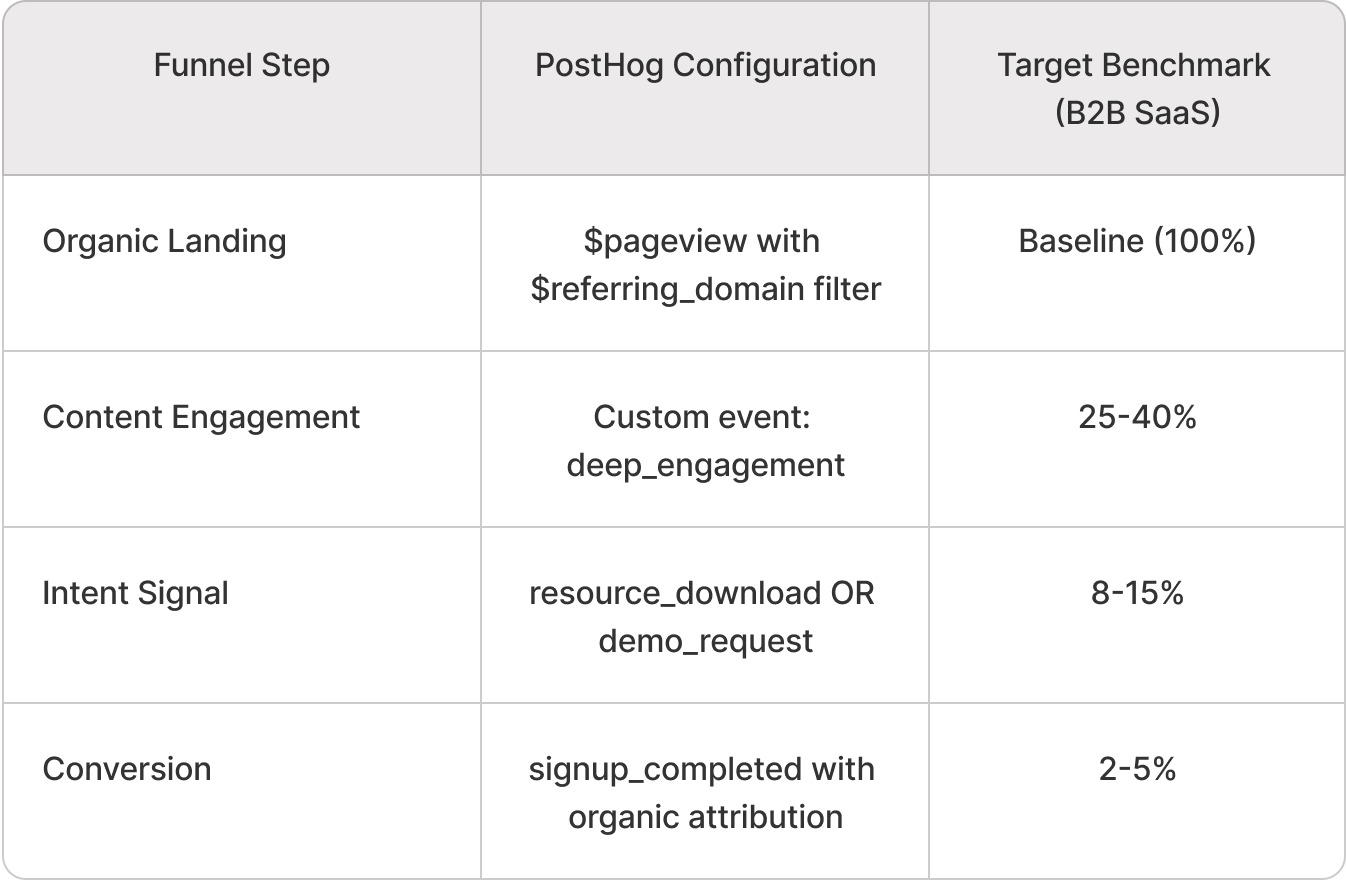
The foundation of SEO conversion tracking lies in funnel analysis that maps the complete journey from organic discovery to revenue outcome. In PostHog, create a funnel that starts with organic page views and progresses through your specific conversion milestones:
- Organic Landing: Page view with referrer = search engine
- Content Engagement: Time on page > 2 minutes OR scroll depth > 70%
- Intent Signal: Resource download, demo request, or pricing page visit
- Conversion: Signup, purchase, or qualified lead submission
The key insight emerges from step-by-step conversion analysis. If 100 organic visitors reach step 1 but only 15 progress to step 2, your content isn't matching search intent. If 80% move from step 2 to step 3 but only 10% complete step 4, your conversion experience needs optimization.
Cohort retention adds the time dimension that funnel analysis lacks. Create cohorts based on organic acquisition date and track their behavior over 30, 60, and 90-day periods. This reveals whether your SEO strategy attracts high-value users who stick around or generates churny traffic that inflates short-term metrics.
Advanced Metrics: Micro-Conversions by Entity Page
The most sophisticated SEO conversion tracking connects specific content entities to downstream revenue outcomes. This requires custom properties that link page-level engagement to broader business metrics:
// Enhanced page view tracking with entity context
posthog.capture('entity_page_view', {
content_type: 'pillar_post',
topic_cluster: 'product_analytics',
word_count: 3200,
internal_links_clicked: 0, // Incremented via click tracking
cta_interactions: 0, // Incremented via button clicks
session_depth: sessionStorage.getItem('page_count') || 1
});
This granular tracking enables entity-level conversion optimization. You can identify which pillar posts drive the highest conversion rates, which topic clusters attract the most qualified traffic, and which internal linking patterns maximize revenue per visitor.
The compound effect transforms your product-led SEO strategy from content production to conversion optimization. Instead of creating more content to drive more traffic, you double down on entity improvements that drive better conversion rates from existing organic visibility.
How Can You Attribution Conversions to Specific SEO Entities?
True SEO conversion attribution requires connecting individual content pieces to revenue outcomes while accounting for the multi-touch nature of modern buyer journeys. PostHog's event-based tracking system preserves attribution signals across sessions, devices, and time periods, enabling precise entity-level ROI calculation.
Topic Cluster Dashboard Creation
The most powerful SEO conversion insight comes from grouping related content entities and tracking their collective conversion impact. Create PostHog dashboards that segment performance by topic cluster rather than individual pages, revealing which content themes drive sustainable revenue growth.
Start by tagging all content with cluster identifiers during the tracking implementation. When someone views a page about "API rate limiting best practices," tag it as part of your "developer tools" cluster. When they later convert, you can attribute the outcome to the entire thematic area rather than trying to assign credit to a single touchpoint.
// Cluster-aware event tracking
posthog.capture('cluster_engagement', {
primary_cluster: 'developer_tools',
secondary_clusters: ['api_design', 'technical_documentation'],
engagement_score: calculateEngagementScore(),
conversion_likelihood: predictConversionProbability()
});
This approach aligns with how search engines increasingly understand topical authority. Instead of optimizing individual pages in isolation, you're building interconnected entity clusters that reinforce each other's conversion potential through strategic internal linking and semantic relationships.
Schema and Internal Links for Signal Amplification
PostHog conversion data becomes exponentially more valuable when combined with structured data markup that signals entity relationships to search engines. Implement schema markup that connects your content entities to conversion outcomes, creating a feedback loop between SEO visibility and revenue attribution.
The Postdigitalist team uses schema markup to define relationships between educational content and product outcomes, making it easier for both users and search engines to understand conversion paths. When your "API Documentation Guide" includes schema that references your signup process as a related action, you're creating explicit conversion signals that compound over time.
Internal linking strategy should reflect conversion data insights rather than traditional SEO assumptions. If PostHog reveals that visitors who read your pricing comparison posts convert at 3x the rate of those who start with educational content, your internal linking should prioritize paths toward high-converting entity clusters.
Use PostHog's path analysis to identify the most common conversion journeys, then optimize your internal linking to facilitate these proven patterns. This creates a self-reinforcing system where better conversion attribution leads to better content architecture, which drives better conversion rates.
What If Your SEO Conversions Are Lower Than Expected?
When PostHog reveals conversion rates below industry benchmarks, the diagnostic process becomes strategic rather than tactical. Instead of broad optimization attempts, you can use event-level data to identify specific breakdown points in your conversion funnel and address root causes with surgical precision.
Diagnose Dropoffs with PostHog Path Analysis
Path analysis reveals the specific moment when organic visitors disengage from your conversion funnel, often highlighting misalignment between search intent and content delivery. The most common pattern: high-intent organic traffic lands on educational content that doesn't provide clear next steps toward problem resolution.
PostHog's path analysis shows you the exact sequence of pages, clicks, and interactions that precede both conversions and exits. Look for patterns where visitors move from high-value content to low-converting pages, or where they engage deeply with content but never encounter conversion opportunities.
Create custom paths that start with organic landing pages and track both successful conversion journeys and common exit points. This identifies whether your conversion problems stem from traffic quality, content relevance, or conversion experience design.
The insight often challenges conventional SEO wisdom. Sometimes your highest-traffic content entities perform worst for conversions because they attract broad, early-stage traffic rather than qualified prospects. PostHog's data helps you decide whether to optimize these entities for better conversion or double down on lower-traffic, higher-converting content clusters.
A/B Testing Entity Content for Conversion Optimization
Once you've identified conversion bottlenecks, PostHog enables sophisticated testing that goes beyond traditional landing page optimization. You can test different content approaches, internal linking strategies, and conversion experiences while maintaining attribution to specific organic traffic segments.
The key is testing entity-level changes rather than page-level tweaks. If your "project management software comparison" cluster converts poorly, test different narrative structures, comparison frameworks, or integration with your product positioning. PostHog tracks how these changes affect conversion rates specifically for organic traffic, isolating SEO impact from other channels.
// A/B test tracking for content optimization
posthog.capture('content_test_view', {
test_variant: 'narrative_driven_comparison',
control_variant: 'feature_comparison_table',
traffic_source: 'organic_search',
content_entity: 'project_management_comparison',
conversion_within_session: false // Updated when conversion occurs
});
This testing approach transforms your SEO strategy from content production to conversion science. Instead of creating more content to drive more traffic, you systematically improve the revenue potential of existing organic visibility through data-driven optimization.
Remember that AI topic clustering can help identify related content that should be tested together as coherent entity groups rather than isolated pages.
How Do You Scale PostHog SEO Tracking into a Revenue Flywheel?
The ultimate goal of sophisticated SEO conversion tracking isn't better reporting—it's creating a systematic feedback loop where conversion data informs content strategy, which improves topical authority, which drives better organic visibility, which generates more qualified traffic for optimization. PostHog becomes the data foundation for this compound growth system.
Export to BI Tools for Investor-Ready Reports
PostHog's SQL interface and API enable seamless data export to business intelligence platforms, transforming SEO from a marketing cost center into a measurable revenue channel with clear unit economics. This integration is crucial for founders who need to prove content marketing ROI to investors focused on scalable growth channels.
Create automated reports that connect organic traffic acquisition to customer lifetime value, showing not just conversion rates but long-term revenue impact from SEO investments. The key metrics for investor presentations:
- Customer Acquisition Cost (CAC) by Content Cluster: Total content production cost divided by attributed customers
- Lifetime Value (LTV) of Organic Customers: Revenue tracking from PostHog cohort analysis
- LTV:CAC Ratio by Topic Area: Identifying your most profitable content themes
- Organic Revenue Attribution: Direct revenue tracking from search traffic
-- Example query for investor-ready SEO ROI reporting
SELECT
properties.content_cluster,
count(distinct person_id) as customers_acquired,
sum(properties.revenue) as total_revenue,
avg(properties.revenue) as avg_customer_value,
sum(properties.revenue) / count(distinct person_id) as revenue_per_customer
FROM events
WHERE event = 'purchase_completed'
AND properties.acquisition_channel = 'organic_search'
AND timestamp >= now() - interval '90 days'
GROUP BY properties.content_cluster
ORDER BY total_revenue DESC;
This level of reporting transforms your SEO program from experimental content creation into a predictable growth channel with measurable returns on investment.
Loop Data Back into Content Strategy
The most sophisticated application of PostHog SEO tracking creates a closed-loop system where conversion performance directly influences content production priorities. Instead of creating content based on keyword research or competitor analysis, you optimize for entity clusters that demonstrate proven conversion potential.
This approach fundamentally changes how you think about content planning. Rather than chasing traffic volume through broad educational content, you double down on specific entity clusters that attract qualified prospects and facilitate conversion outcomes. Your growth operator playbooks should prioritize content that performs well in PostHog conversion analysis.
The feedback loop works like this: PostHog identifies high-converting content entities → you create more content in those clusters → improved topical authority drives better organic rankings → increased qualified traffic flows through proven conversion paths → higher revenue attribution justifies additional content investment.
At this level, SEO becomes a systematic growth channel rather than a marketing experiment. You're not hoping that content drives conversions—you're systematically reinforcing the specific content-to-revenue pathways that PostHog proves work for your business model.
If you're ready to implement this level of systematic, data-driven content strategy that turns SEO conversion tracking into a competitive moat, The Program provides the frameworks, templates, and operator guidance to build entity-first growth systems that scale with your business.
Conclusion
Tracking SEO conversion rate with PostHog isn't just about better analytics—it's about building a systematic growth engine where every piece of content serves measurable business outcomes. By implementing entity-first tracking, funnel analysis, and cohort-based attribution, you transform organic traffic from a vanity metric into a predictable revenue channel with clear unit economics.
The compound effect extends far beyond conversion optimization. When you understand which content entities drive qualified traffic, which internal linking patterns facilitate conversions, and which topic clusters generate the highest lifetime value customers, your entire content strategy becomes more strategic and more profitable.
This approach differentiates your SEO program from competitors who chase traffic volume without understanding revenue impact. You're building topical authority around proven conversion themes, creating content that serves both search engine visibility and business growth objectives.
The methodology scales with your business. As you gather more conversion data, your content strategy becomes more precise. As your topical authority grows, your organic visibility increases. As more qualified traffic flows through optimized conversion paths, your revenue attribution strengthens. PostHog provides the data foundation that makes this flywheel possible.
Ready to implement entity-first SEO conversion tracking that scales revenue rather than just traffic? Book a strategy call to audit your current analytics setup and design a PostHog implementation that turns your content into a measurable growth channel.
FAQs
How long does it take to see meaningful SEO conversion data in PostHog?
You'll start seeing basic conversion funnel data within 48 hours of implementation, but statistically significant insights require 2-4 weeks of data collection. The key is starting with proper event architecture from day one—retroactive tracking is impossible, so implement comprehensive event tracking immediately rather than waiting for perfect configuration.
Can PostHog replace Google Analytics for SEO tracking?
PostHog and GA4 serve different purposes in a sophisticated SEO operation. Use GA4 for broad organic traffic trends and search performance data, while PostHog handles conversion attribution and customer journey analysis. The combination provides both high-level SEO visibility and granular conversion insights that neither tool delivers alone.
What's the difference between PostHog funnels and GA4 conversion paths for SEO?
PostHog funnels maintain user attribution across multiple sessions and devices, while GA4 conversion paths often lose attribution threads when users return via direct navigation. For content-driven businesses where consideration cycles span weeks or months, PostHog provides more accurate attribution of organic traffic to eventual conversions.
How do you handle attribution when users convert after multiple organic sessions?
PostHog's person-based tracking automatically connects multiple sessions to the same user profile, preserving organic attribution even when users return via direct traffic or other channels. Create custom properties that flag "organic influenced" conversions even when the final session isn't from search traffic.
Should you track micro-conversions or focus only on revenue events?
Track both, but weight them differently in your analysis. Micro-conversions like resource downloads or email signups provide early signals about content effectiveness, while macro-conversions prove revenue impact. Use micro-conversion data for rapid optimization cycles and macro-conversion data for strategic resource allocation decisions.
How do you prove SEO ROI to stakeholders using PostHog data?
Create cohort reports that track the lifetime value of organically acquired customers compared to other channels. Show not just conversion rates but customer quality metrics like retention, expansion revenue, and support costs. This proves that SEO drives valuable customers, not just cheap traffic.